|
|
|
|
|
How The Elk Came Home One hundred years ago, elk roamed the mid-western plains and the southern mountain region, making their home in the grasslands as far south and east as northern Alabama. Settlers who discovered the rich lands in the mid-1800s pushed the elk westward into the rougher terrain of the Rockies, but today the big animals are making a comeback in at least one area of their former domain. The Arkansas Game and Fish Commission made an agreement with the Colorado Department of Natural Resources in 1980 to trade Arkansas largemouth bass for this noble member of the deer family and now Newton County has an elk herd conservatively estimated at about 450 animals.
In March, 1981, the first trailer load of Colorado elk was delivered to Newton County. Over the next three years, several more loads were brought, along with seven elk that were a gift from a park in Nebraska. During that time, the new herd reached an estimated 45 in number, but the winter of 1985 was to prove the exciting one for elk enthusiasts. Local volunteers raced winter storms across the great plains to bring back seven loads containing 74 new elk. They were unloaded in various locations along the Buffalo National River and for the most part the elk have stayed close to the river bottom fields. Bobby Harrison of Jasper is one of the volunteers who helped bring back elk. "They're mean, wild and stout," Harrison said. The volunteers took gooseneck cattle trailers lined with plywood sheets to pick up their cargo. "If there was a small crack they could see through, they'd go for it. At night, the car lights coming up behind us and shining through the cracks really startled them."
Colorado wildlife officers used man-high shields built of plywood to hold up in front of them when they went into the pens to work the elk into the chutes. Occasionally, an angry elk would turn on the trappers and attack the shield with flashing front hooves. The volunteers donated their time and equipment only partly because of hunting considerations. "A lot of people here would never get a chance to see them if we hadn't brought them in," Harrison said. "I'm just tickled to death with the way they're doing and with having them here." Elk are vigorous and hardy and they are browsers who can find plenty of food in places where deer cannot. The elk eat grass, hardwood and conifer brush and some rough weeds deer won't touch. Their mating season is in the fall, usually October, and is characterized by a far reaching bugle call sounded by the bulls which descends the scale to a low rumble. The massive animals, which may stand five feet high at the shoulder and weigh from 600 to 1000 pounds, also fight extensively during the season, facing each other from 20 feet apart and charging with lowered head. Although serious injury is rare, the massive antlers, which spread from three to five feet with five to seven points on each side, have been known to become hopelessly locked, causing both bulls to die of starvation. The gestation period for the cow is 249 to 269 days and the calves are dropped in May or June. Calves are light colored with white spots. Multiple births do occur, but are rare than in other deer species. The elk are the second largest member of the deer family. The moose is the largest. After a hundred year absence, The elk are finding they fit well, after all, with descendants of those who once pushed them westward. |
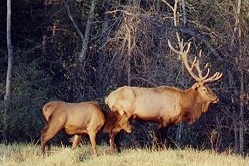 Elk
became extinct through over hunting, natural mortality and shrinkage of
suitable grazing land.
In 1981,
through the efforts of Hilary Jones and other Newton County residents, the
Arkansas Game and Fish Commission, initiated an elk restoration project
for the Ozark Mountains. Between 1981 and 1985, 112 elk from Colorado
and Nebraska were released at five sites near Pruitt in Newton County.
These sites were on or adjacent to the Buffalo National River where
grassy meadows provide an ideal habitat for the elk. Since that time,
the herd has grown to approximately 450 and are found all along the
river at Boxley Valley, Steel Creek, Kyle's Landing, Erbie, Ozark,
Pruitt, and even on private lands. Because of this successful
restoration of elk to our area, on July 22, 1998, Senator Randy Laverty
persuaded Governor Mike Huckabee to
officially proclaim Newton County as the Elk Capital of Arkansas. It is a
special treat to see and photograph these magnificent animals--a
memorable experience for all.
Elk
became extinct through over hunting, natural mortality and shrinkage of
suitable grazing land.
In 1981,
through the efforts of Hilary Jones and other Newton County residents, the
Arkansas Game and Fish Commission, initiated an elk restoration project
for the Ozark Mountains. Between 1981 and 1985, 112 elk from Colorado
and Nebraska were released at five sites near Pruitt in Newton County.
These sites were on or adjacent to the Buffalo National River where
grassy meadows provide an ideal habitat for the elk. Since that time,
the herd has grown to approximately 450 and are found all along the
river at Boxley Valley, Steel Creek, Kyle's Landing, Erbie, Ozark,
Pruitt, and even on private lands. Because of this successful
restoration of elk to our area, on July 22, 1998, Senator Randy Laverty
persuaded Governor Mike Huckabee to
officially proclaim Newton County as the Elk Capital of Arkansas. It is a
special treat to see and photograph these magnificent animals--a
memorable experience for all.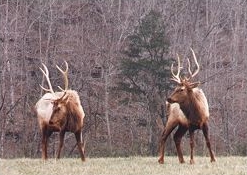 The
herd was officially named the Hilary Jones Elk Herd in honor of a
commission member from Pruitt who instigated the program. An avid elk
hunter, Jones hoped someday there would be a local season.
The
herd was officially named the Hilary Jones Elk Herd in honor of a
commission member from Pruitt who instigated the program. An avid elk
hunter, Jones hoped someday there would be a local season. 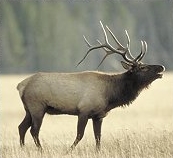 Harrison
described how the trapping worked. Colorado authorities built corrals
from ten foot tall sections of fence with heavy duty steel pipe frames
and nylon mesh fencing, which prevents injury when the animals run into
it trying to escape. The panels are fastened together and formed into
large circular pens. A built-in squeeze chute provides access to the
animals for shots, blood tests, and aging after they are trapped and is
also used for loading the trailers.
Harrison
described how the trapping worked. Colorado authorities built corrals
from ten foot tall sections of fence with heavy duty steel pipe frames
and nylon mesh fencing, which prevents injury when the animals run into
it trying to escape. The panels are fastened together and formed into
large circular pens. A built-in squeeze chute provides access to the
animals for shots, blood tests, and aging after they are trapped and is
also used for loading the trailers.